The Sunset of the Supernova: The Rise and Fall of The Rock Star Mythos
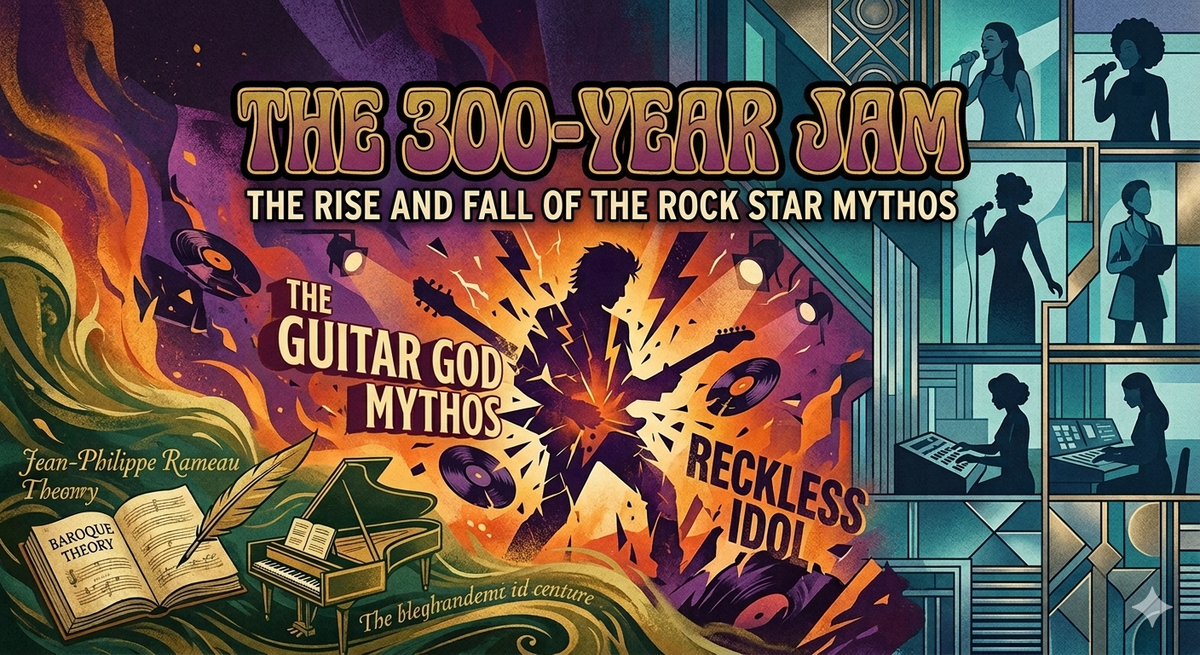
The "300-Year Jam" is reaching its most profound shift yet. While the 1720s built the foundation of harmony and the 1970s built the temple of excess, the 21st century is systematically dismantling the very idea of the "Rock Star." What was once a reckless, male-dominated religion is now being replaced by a sophisticated, professionalized, and equitable architecture of power.
The Secret Language: Rameau’s DNA
In 1722, Jean-Philippe Rameau published his Traité de l'harmonie, a document that fundamentally changed how we understand sound. By viewing chords as "vertical blocks," Rameau provided the mathematical blueprints for everything that followed. This "secret language" allowed 18th-century harpsichordists and 1970s fusion guitarists to speak the same dialect of improvisation—the shared DNA of the "Jam."
"The Golden Age of the "Guitar God"
In the 1970s, the Rock Star was a modern deity. Figures like Jimmy Page, Pete Townshend, Jimi Hendrix, Eric Clapton, Joe Walsh, Eddie van Halen, Mick Jagger, Kieth Moon, Richie Blackmore, Jeff Beck, and Carlos Santana lived a lifestyle of excess that was practically Victorian in its scale of "lords and servants." Central to this was the Groupie Culture—a subculture rooted in a deeply imbalanced power dynamic. This era birthed the "Eye Candy" phenomenon, where the Supermodel emerged as the ultimate "muse" and accessory to the male legend. Fashion industry growth in the 70s was directly tethered to this "Rock Legend" lifestyle, turning velvet, leather, and rebellion into a global uniform.
The Shift: The Rise of the Female Rock Icon
As the 70s bled into the 80s, the "male dominance" of the stage began to crack. Women like Stevie Nicks, Patti Smith, Pat Benatar, Joan Jett, and Chrissie Hynde of The Pretenders stopped being the "muse" and started being the "message." However, the most significant disruption came from the band Heart.
Ann and Nancy Wilson forced the industry to rethink its gendered hierarchies. Nancy Wilson emerged in the mid-70s as perhaps the first true Female Guitar God. Heavily influenced by the technical mastery and songwriting of John Lennon, Jimmy Page, Neil Young, and Steve Howe, Nancy was often the only woman standing amidst the "Guitar Gods" of the era. She proved that a woman could command a hard-rock stage with the same technical ferocity and acoustic complexity as her male heroes.
The Culture Shifters: Madonna and Lady Gaga
The dominance of the male "Guitar God" continued to crumble with the arrival of the Culture Shifters.
- Madonna didn't just join the industry; she engineered it. She took the visual language of the 80s and turned it into a weapon of female autonomy, moving the focus from the "backstage muse" to the "center-stage CEO."
- Lady Gaga followed, fusing high-fashion, theater, and pop into a multi-dimensional art form that made the old "jeans and leather jacket" rock aesthetic look like a relic of the past.
The 21st Century: The Death of the Reckless Idol
Today, the "Rock Star Lifestyle"—characterized by hotel-room wreckage and drug-fueled benders—is largely viewed as a relic of a less enlightened time. What was once seen as "cool" is now understood as destructive and reckless at best. The 21st century has seen a total abandonment of this archetype for several reasons:
- Professionalization: Modern artists are CEOs of their own brands; there is no room for a "bender" when managing a global tour and digital presence.
- The Feminist Reckoning: Modern feminism has dismantled the "Groupie" structure. The dominance of men in the music and fashion hierarchies has been challenged by a generation of women who occupy the boardroom and the recording booth.
- Health and Longevity: The "Live Fast, Die Young" mantra has been replaced by a focus on mental health and longevity.
The Crumbling Temples: Retail in Ruins
The most tangible sign that the Guitar God is dead can be found on the empty sales floors of its most iconic institutions. The physical spaces where musicians once gathered to "try before they buy" are disappearing.
- Iconic Closures:
- Legends like Steve’s Music Store in Toronto and Cosmo Music in Canada have shuttered their physical locations. In the USA, the century-old Sam Ash has gone out of business, while the industry giant Guitar Center has faced bankruptcy restructurings. Even the legendary Norman’s Rare Guitars in Los Angeles recently sold its personal collection—marking the end of the "gatekeepers."
The Vintage Bubble: Will the Million-Dollar Guitar Survive?
The massive market for Classic Vintage Guitars—1950s Les Pauls commanding millions of dollars—is a bubble driven exclusively by Boomer nostalgia. As the Boomer generation passes on, this market faces a catastrophic correction.
- The Financial Tumble: For a new generation facing hard economic challenges, a vintage guitar has little cultural or investment value. They focus on technology, not "relic-ed" wood.
- The Cultural Deletion: Without the emotional tether of the 70s, these "Million-Dollar" instruments will likely see their prices tumble, reduced to rubble along with the classic rock anthems they once played.
Conclusion: The Sunset of the Supernova
As we move deeper into the 21st century, the reality of Classic Rock is becoming clear: it is a generational phenomenon. Once-mighty stadium fillers from legends like Led Zeppelin, Deep Purple, Doobie Brothers, Yes, Santana, The Guess Who, Eric Clapton are increasingly relegated to casino events and nostalgia circuits.
Modern feminism and a new professional ethos have replaced the "Groupie" with the "Creator." The "Guitar God" is dead, and in his place is a more equitable, healthy, and sustainable creative landscape. Classic Rock may eventually find itself in the "dust bin" of music history—a fascinating chapter of 20th-century rebellion that faded out as the world learned to jam to a different, more empowered beat.