The 300-Year Jam
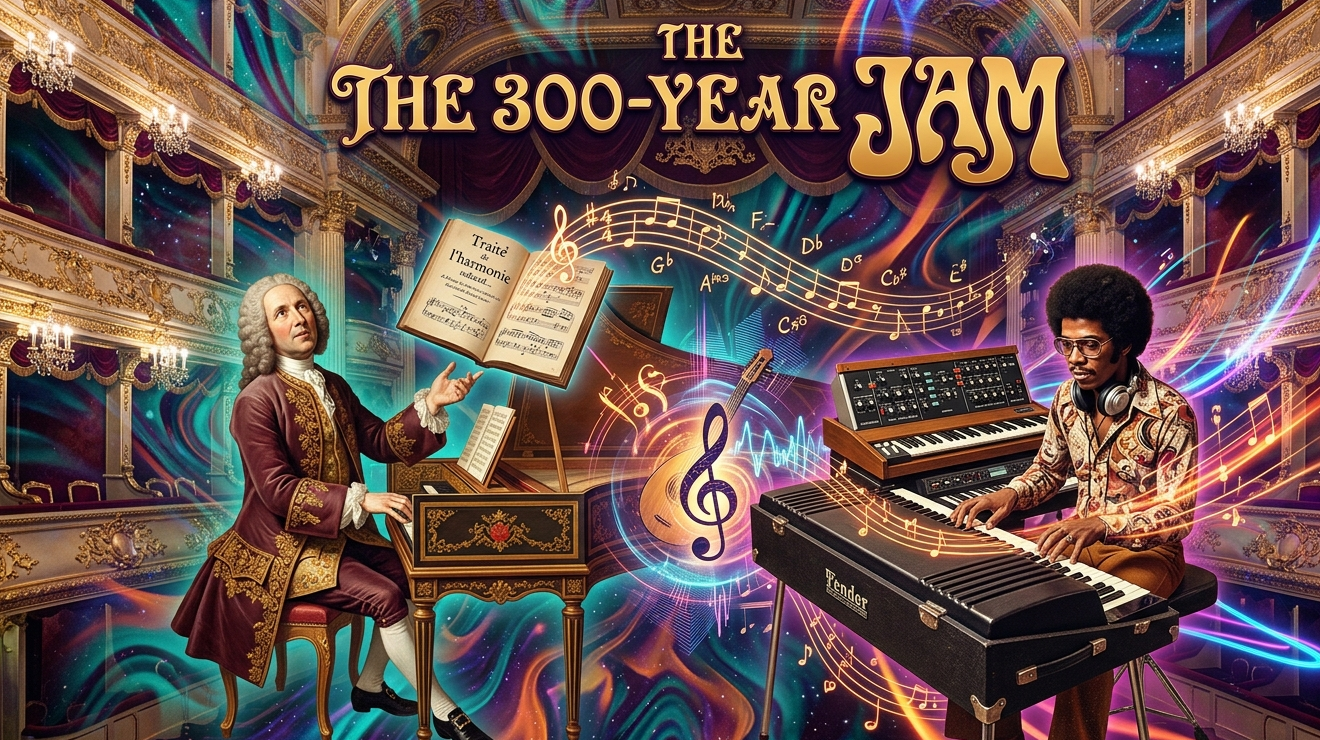
Why Rameau Would Have Loved Jazz Fusion
The evolution of Jazz Fusion was a revolutionary shift that dismantled the boundaries between genres. This movement was a deliberate act of musical alchemy. Developed in the late 1960s, it combined the sophisticated harmonies of jazz with the raw energy of rock and the spiritual depth of global traditions.
The Secret Language: Figured Bass and Lead Sheets
One of the most striking links between 1722 and 1972 is how musicians "read" music. A Baroque harpsichordist in the era of Jean-Philippe Rameau and a modern fusion guitarist are actually using the same musical shorthand.
- Baroque "Figured Bass": Musicians read a simple bass line with numbers underneath that indicated which intervals to improvise above it.
- Jazz "Lead Sheets": Fusion players use a melody line with chord symbols to guide their improvisation.
In both worlds, the composer provides only a "skeleton," trusting the performer’s virtuosity to "flesh out" the piece in real-time. This shared DNA is why Baroque music often sounds surprisingly "jazzy" when played with a modern swing.
Rameau: The Original Jazz Theorist
In 1722, Rameau published his Traité de l'harmonie (Treatise on Harmony), which changed music forever. He was the first to view chords as vertical blocks of sound rather than just overlapping lines. This "vertical" way of thinking is exactly how modern jazz theory functions today. If you’ve ever used a "chord chart" to play a song, you are speaking a language that Rameau formalized three centuries ago.
The Architects of Global Fusion
In the 1970s, a collective of virtuosos began weaving Western Classical discipline with the rhythmic and melodic languages of the world.
1. The Chamber-Jazz Vision: Oregon & Ralph Towner
The band Oregon was a unique anomaly. While others used heavy synthesizers, they treated the jazz ensemble like an 18th-century chamber group. Ralph Towner utilized concert piano and classical guitar techniques to create structures that felt "Old World," while Collin Walcott—a student of Ravi Shankar—introduced the sitar and tabla. Their "acoustic fusion" proved that the spiritual "raga" scales of India could resonate perfectly within a Western classical framework.
2. The Progressive Alchemists: Zappa, King Crimson, YES, & ELP
These artists looked to the European "Old World" to push rock into the avant-garde.
- Frank Zappa: A disciple of modern classical composers, Zappa's work blended rock energy with 20th-century orchestral precision.
- King Crimson & Yes: These bands replaced blues-based riffs with classically influenced structures, "Mellotron" textures, and complex time signatures.
- ELP (Emerson, Lake & Palmer): They famously reimagined full classical works for the synthesizer, bringing the scale of a cathedral to the rock stage.
3. Global Pulses: Brazil and Africa
Innovators like Airto Moreira and groups like Weather Report and Passport transformed the pulse of jazz. By integrating Brazilian instruments like the berimbau and complex African polyrhythms, they moved the music beyond the standard 4/4 rock beat, creating a "global heartbeat" that felt both ancient and futuristic.
The Next Horizon: The Evolution of Virtuosity
The "300-year jam" didn't stop in the 1970s; it evolved into a high-octane, technical discipline that redefined the limits of what a band could achieve. This new generation took the complexity of Rameau’s structures and the global curiosity of Oregon and infused them with modern, heavy-hitting precision.
1. The Progressive Metal Fusion: Tool & Dream Theater
While technically categorized as rock or metal, bands like Tool and Dream Theater are deep-rooted in the fusion tradition.
- Tool: Much like the mathematical spirituality of the sitar and the synth, Tool utilizes the Fibonacci sequence and polyrhythmic structures that mirror the complex "talas" of Indian classical music.
- Dream Theater: Their keyboardist, Jordan Rudess, is a Juilliard-trained virtuoso who seamlessly blends classical piano technique with screaming synthesizer leads, directly echoing the "Rock Orchestra" energy of ELP.
2. The Modern Virtuosity: UZEB & Jovian Fusion Band
- UZEB: This French-Canadian powerhouse (led by Alain Caron) was the bridge between 80s synth-tech and high-level jazz improvisation. They utilized midi-guitars and fretless bass to create a sound that was as pristine as a Baroque salon but as energetic as a modern arena.
- Jovian Fusion Band: Representing the new vanguard, groups like Jovian push the "Global Alchemy" into the digital age. They blend jazz-rock with world-music textures, proving that the "Global Pulse" we saw in the 70s is still beating in the contemporary underground.
The Infinite Stage
From Rameau’s first vertical chord in 1722 to the complex, distorted rhythms of Tool in the 21st century, the goal has remained unchanged: to find the "harmony of the spheres." Whether it’s played on a gut-string harpsichord or a 7-string Ibanez guitar, the 300-year jam is an infinite conversation that continues to reinvent itself with every generation.
A Universal Resonance
Rameau believed that the rules of harmony were derived from nature’s "vibrating world." This mirrors the philosophy of fusion pioneers like John McLaughlin and Pat Metheny, who see music as a universal, mathematical, and spiritual force.Whether it is the "plucked" resonance of a harpsichord or the electric sustain of a jazz guitar, the goal has always been the same: to find the "harmony of the spheres" across time and culture. This is the great convergence—a concert that began in the 1700s and continues to evolve on every stage today.