Organized Sound: The Avant-Garde Architectures of Canadian Fusion Jazz
From the jagged rhythms of Stravinsky to the high-tech MIDI-pioneers of UZEB, discover how Canadian Fusion Jazz escaped the Institutional Matrix.
By: Nelson Jovian
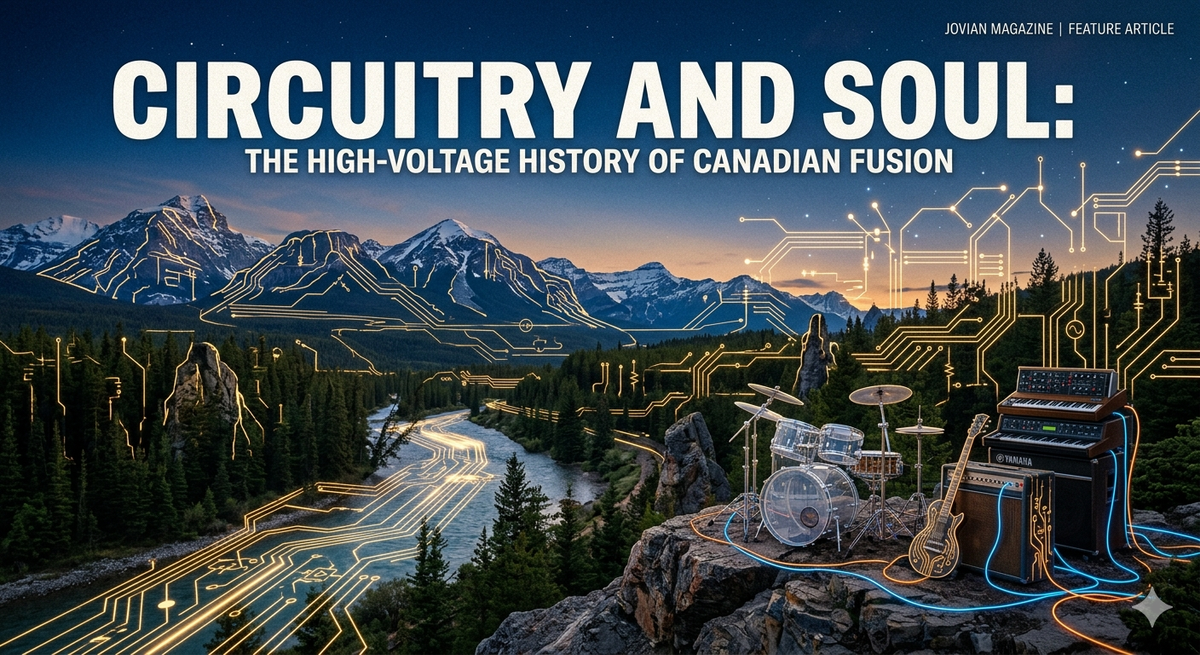
While Miles Davis was plugging in his trumpet in New York, a group of virtuosos in a Montreal basement were reimagining the soul of the guitar through a circuit board. To the uninitiated, the 1970s and 80s in Canada might bring to mind the stadium-filling prog of Rush, but beneath that surface hummed a high-voltage current of Fusion Jazz—a movement that was as technically precise as a symphony and as rhythmically explosive as a world-beat carnival.
The Architects of the Landscape: Rush and Max Webster
The massive success of Rush and the quirky, brilliant complexity of Max Webster created the fertile soil where Canadian fusion jazz first took root. These weren't just rock bands; they were the architects of a "Prog-Fusion" landscape that leaned heavily into intricate, non-blues-based structures.The fans who loved the polyrhythms of Neil Peart or the harmonic zig-zags of Kim Mitchell were the same fans crowding into Toronto’s El Mocambo or Montreal’s L’Air du Temps to see fusion jazz players push the limits of their instruments. This uniquely Canadian appetite for complexity paved the way for a parallel movement building a new world out of dissonance and data. This wasn't just music; it was "organized sound"—a phrase coined by Edgard Varèse, the "Father of Electronic Music."
The Holy Trinity of Dissonance: Varèse, Stravinsky, and Webern
Canadian fusion Jazz players didn't just listen to Miles Davis; they studied the revolutionaries who broke music apart. They looked to the same titans who shaped the complex, dissonant mind of Frank Zappa:
- Edgard Varèse: He replaced traditional melody with texture and "spatial distribution," proving that noise could be art.
- Igor Stravinsky: His rhythmic brutality in The Rite of Spring gave fusion jazz its jagged, technical "heartbeat."
- Anton Webern: He reinterpreted twelve-tone music with an abstract sparseness that allowed the listener to find melody in the silence.
These innovators were the primary fuel for Zappa, whose high-precision masterpieces (like Hot Rats) became the bible for Canadian musicians who wanted to escape the "Matrix" of standard pop structures.
The Canadian Laboratory: UZEB and the Zappa Influence
Montreal’s UZEB (Alain Caron, Michel Cusson, and Paul Brochu) took this avant-garde torch and ran it through a MIDI-converter. They weren't just playing chords; they were creating "air sculptures." By merging the cold, mathematical precision of Webern with the electric-blue energy of 80s synthesis, UZEB moved fusion jazz away from American "soul" and toward a uniquely Canadian "industrial-classical" aesthetic. They proved that the complexity of a Stravinsky score could live inside a MIDI-guitar.
The Distortion of the Soul: The Institutionalized Matrix
As we moved into the 90s and 2000s, the "free spirit" of fusion jazz faced its greatest threat: the school system. Jazz, originally the ultimate language of free expression, was systematically pulled into the "Matrix of the Institution."Today, we face a crisis where creativity is confused with curriculum. You can teach the theory of music, but you cannot teach creativity. Schools have created a generation of players who are masters of the Matrix—they play with perfect technique but are often fighting their own God-given nature inside. Varèse and Stravinsky were the ultimate rebels; they would have detested the idea of a "Jazz School" where everyone is taught to copy the same innovators.
The Underground Renaissance: Reclaiming the Spirit
Fusion Jazz did not die; it simply went underground to escape the "expiry date" of the administrative machine. Today, we are seeing a resurgence of that free-spirited sound in the Jovian Fusion Band and a new wave of Canadian innovators who reject the "Institutionalized Jazz" model:
- Pangea: Led by saxophonist Patrick Smith, this project blends Arabic melodies, R&B, and neo-soul with the spiritual jazz legacies of Sun Ra and Coltrane.
- Mafuba: A Montreal-born ensemble that creates a "beautifully chaotic dish of music," mixing jazz, punk, and hardcore into a gritty, improvised sound.
- Lavender Town: This Toronto-based group approaches modern jazz from a hyper-contemporary angle, fusing virtuosic "maximalism" with video game music and lofi hip-hop.
- Misc: A Montreal trio that blurs boundaries between jazz, pop, rock, and electronic music, focusing on overall cohesion rather than individual virtuosity.
- TransQueb: A Quebec-based ensemble that seamlessly blends jazz fusion and progressive rock, offering a musical journey through unusual sonic atmospheres.
These modern architects, alongside international stars like Snarky Puppy (featuring Canadian drumming phenomenon Larnell Lewis), represent a return to the avant-garde spirit. They understand that true fusion jazz isn't about following a textbook; it’s about the courage to "organize sound" in a way that is authentically unique to their own soul.
_________________________________________________________
Trademark Disclaimer:
The names of artists, bands, and trademarks mentioned in this article are the property of their respective owners. These names are used solely for editorial and descriptive purposes to identify historical figures and musical groups. Use of these names does not imply any official affiliation with, or endorsement by, the artists or their representatives.